Quadratic voting and credits
Give voters a credit budget where piling votes on one candidate gets expensive.
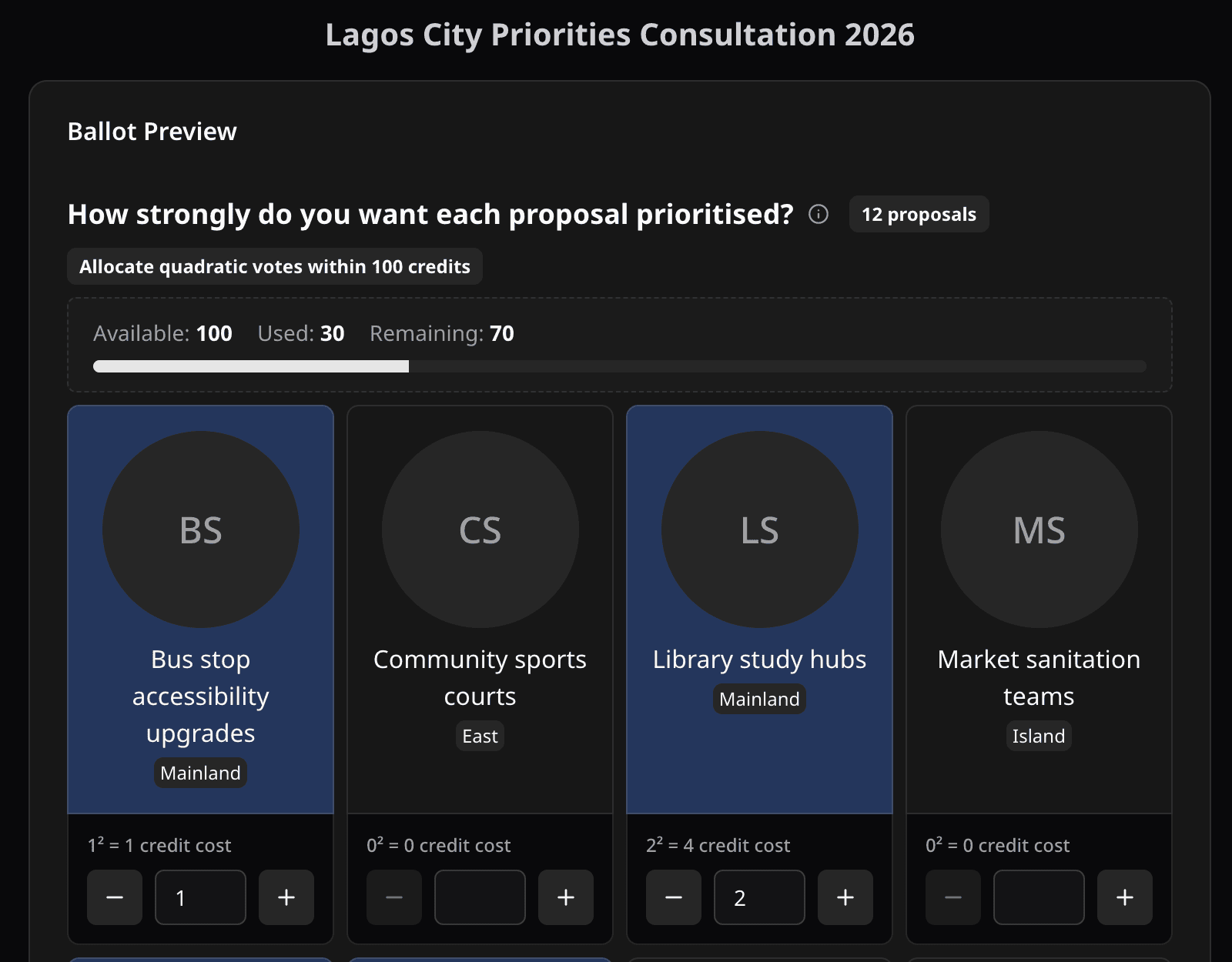
In quadratic voting, each voter gets a credit budget per position. Giving a candidate 1 vote costs 1 credit, 2 votes cost 4, 3 votes cost 9. Two votes for A and three for B cost 13 credits. This rewards spreading support over stacking it.
Needs
- A Starter or Custom plan.
- An event end date. The position will not save without one.
- Weighted voting off. The two cannot be combined in one event.
Set it up
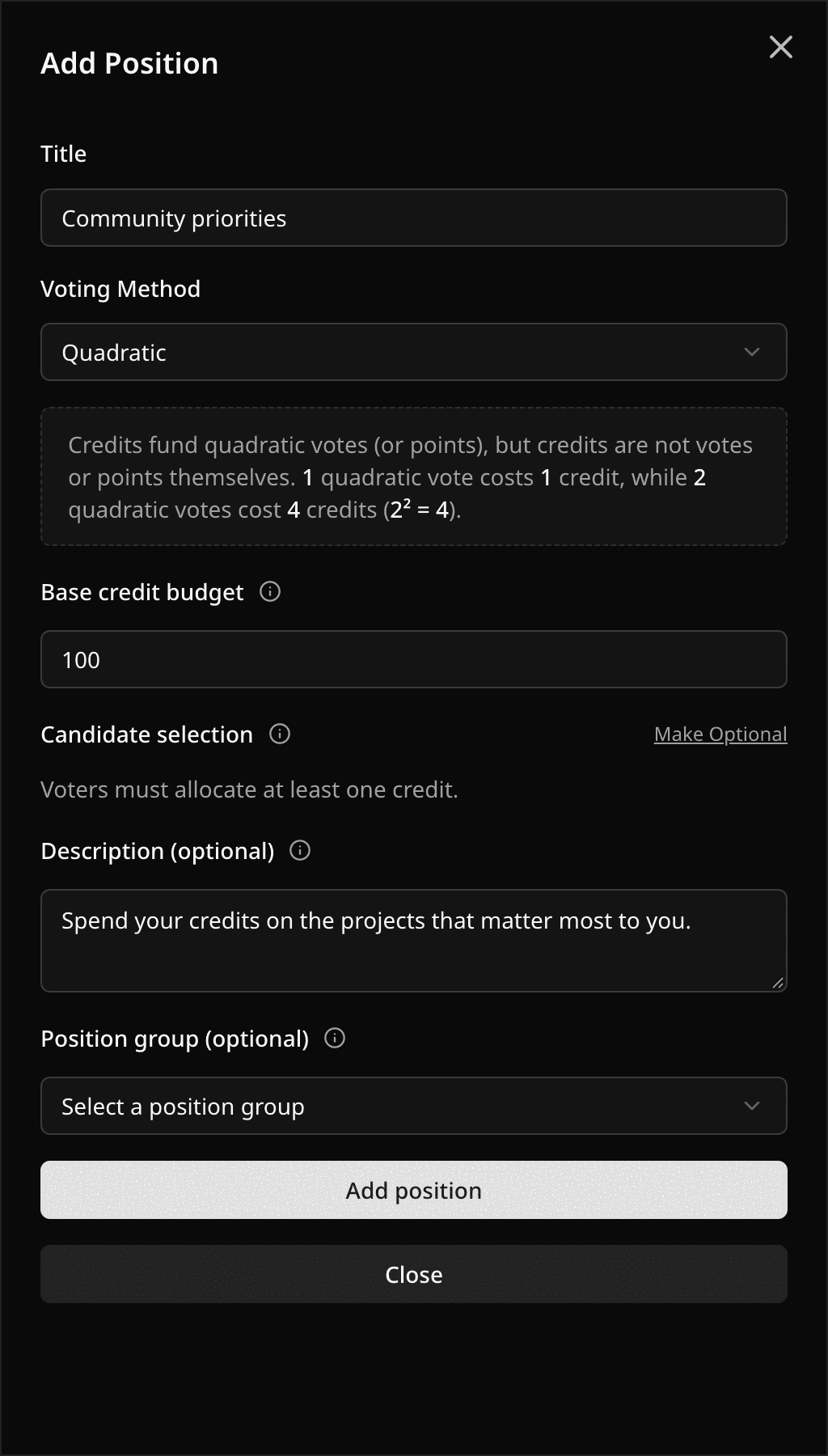
On the position, set Voting Method to Quadratic and set the Base credit budget per voter. Choose whether voters must spend at least one credit or may leave the position blank.
Credit cost power sets how votes are priced. See Credit cost power below.
Credit cost power
Each quadratic position has a credit cost power. It sets how many credits a number of votes for one candidate costs. Pepvote supports two powers.
| Power | 3 votes cost | Best for |
|---|---|---|
| 2 (default) | 9 credits (3²) | Elections and polls where you want support spread out |
| 1 | 3 credits | Paid fan votes, such as pageants, where 1 credit buys 1 vote |
Costs add up across candidates. At power 2, 2 votes for A and 3 for B cost 4 + 9 = 13 credits. At power 1, the same votes cost 2 + 3 = 5 credits.
At power 1 the ballot does not show the squared cost, because credits equal votes. You cannot change the power after votes are cast.
Selling extra credits (polls)
In a poll with Pay to Vote on, you can turn on Allow credit top-ups, cap purchased credits per voter, and set a price per credit or credit tiers. Purchased credits add to that position's budget. A base budget of 0 means voters must buy credits to take part.
Unpaid credit checkouts are released after 60 minutes, or immediately if the voter cancels.
Related help
Last updated October 16, 2026