Pepvote API overview
Use the Pepvote API to manage voting data from your server.
The Pepvote API lets your server read and manage data in voting events that your API key can access. The base URL is https://api.pepvote.com.
The API uses JSON, bearer API keys, cursor pagination, and standard HTTP status codes. It does not support browser CORS. Keep keys on your server.
Start here
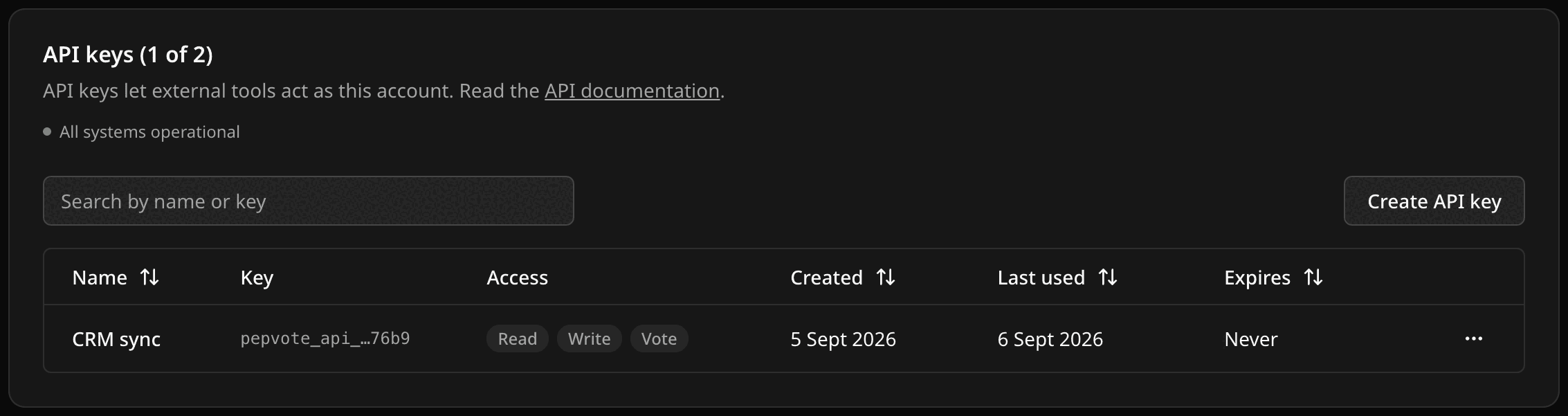
- Create an API key in Profile → API keys.
- Send it as a bearer token.
- Use the quick start to test
/me. - Read pagination and errors before you build a sync.
API conventions
- Requests and responses use JSON.
- Timestamps are Unix milliseconds.
- Successful single-resource responses use
{ "data": ... }. - List responses use
{ "data": [...], "nextCursor": ... }. POSTrequests accept an optionalIdempotency-Keyheader.- Unknown JSON fields and query parameters return an error. This helps catch spelling mistakes.
Endpoint groups
| Group | What it covers |
|---|---|
| Public voting | Build a voting interface, register, cast, confirm, and read results |
| Payments | Payment businesses, event links, checkout, and payment status |
| Pricing | Vote, candidate registration, and quadratic credit prices |
| Uploads | One-hop image uploads and storage IDs |
| Voting events | Events, logos, and event statistics |
| Positions | Positions, voting settings, and batch creation |
| Candidates | Candidates, avatars, approval, and batch creation |
| Groups | Event groups, logos, and batch creation |
| Sponsors | Event sponsors and logos |
| Voters | Voters, approval, and batch creation |
| Results | Tally results |
| Votes | Individual vote records |
| Exports | CSV, JSON, and result PDF exports |
| Invites | Voting event collaborator invites |
| Insights | Voting totals, geography, and time series |
| Webhook endpoints | Webhook subscriptions |
API version
The API has no version in the URL. Changes are additive: new fields and endpoints can appear, and existing ones keep their names, types, and status codes. If a breaking change ever becomes necessary, Pepvote will introduce date-based versioning through a request header, and existing integrations will keep the behaviour they were built against.
Every change, and any change announced ahead of time, is listed in the API changelog.
Last updated October 16, 2026